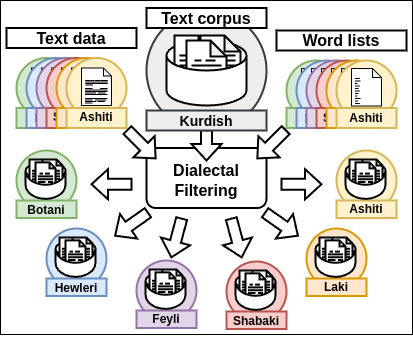
Dialectal Filtering
Synthesising dialect-specific corpora from large noisy text collections
- Datum
- seit 2024
- Status
- aktiv
- Personen
- Raman Ahmad (Co-author)
- Ānrán Wáng (Co-author)
Überblick
Matching dialectal markers in large noisy corpora to synthesise novel dialect-specific text corpora for underrepresented Kurdish varieties.
Overview
Kurdish NLP faces a fundamental data problem: available text corpora are large but extremely noisy, mixing multiple dialects, scripts, and registers without labelling. A model trained on such data learns an undifferentiated blend rather than the properties of any specific variety. Dialectal Filtering addresses this by using lexicographic features - dialect-specific markers identified from linguistic resources - to filter and partition large raw corpora into variety-specific sub-corpora.
The Core Idea
The approach treats dialect identification as a lightweight, lexicon-driven filtering step rather than a full classification task. For each target dialect, a set of discriminative lexical and morphological markers is identified. Documents containing a sufficient density of these markers are assigned to the corresponding dialect sub-corpus. This keeps the pipeline fast, interpretable, and applicable even when only small amounts of labelled data are available.
Results
- Over 100 dialect-specific sub-corpora synthesised from Northern Kurdish (Kurmanji) source data.
- Presented at the 7th International Conference on Kurdish Linguistics (ICKL-7, Bamberg 2025).
- Current limitations in precision are acknowledged; further refinement of the marker lexicon is ongoing.
- [TODO: add quantitative results once finalised for publication]
Connection to the Broader PhD Project
Dialectal Filtering is one of the core data-creation threads of the Dialect-Aware NLP PhD project. The sub-corpora it produces feed directly into downstream tasks such as dialect-aware machine translation and ASR fine-tuning (see: Kurdish Voices).
Next Steps
- Expand the marker lexicon to cover additional Kurdish varieties beyond Northern Kurdish.
- Evaluate downstream task performance (MT, ASR) on the synthesised sub-corpora.
- Investigate combining the lexicon-based approach with lightweight classification models.
- [TODO: add publication link once available]
Schlagwörter
- corpus creation
- dialect identification
- Kurdish
- low-resource
- data augmentation
Bilder
-
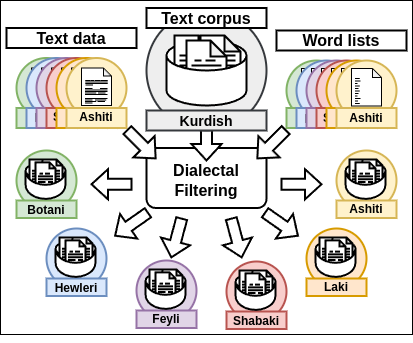
Concept figure of the dialectal filtering approach.